

REPORT SUMMARY:
This study assesses some of the fundamental assumptions underlying residency restrictions and questions whether these laws have the desired effect. Previous research is tested and results are placed in a community context, in order to shed light on the true impact of residency restrictions on housing availability, given the economic realities faced by both offenders and general county residents. The study specifically assesses whether such restrictions place a more substantial burden on the economically most vulnerable. The study utilizes publicly accessible databases maintained by the Franklin County Sheriff and the Ohio Attorney General, and uses the same methodology employed by the Sheriff’s office in determining whether an convicted offender is in violation of current residency restrictions. The report does not make any causal claims and does not offer any opinion on the cause of the economic and demographic trends described.
The following conclusions are drawn:
1. Results indicated little relationship between the proportion of area homes with children under the age of eighteen and the likelihood that a parcel was restricted. This suggests that the creation of buffer zones around schools may not relate to the insulation of children from offenders.
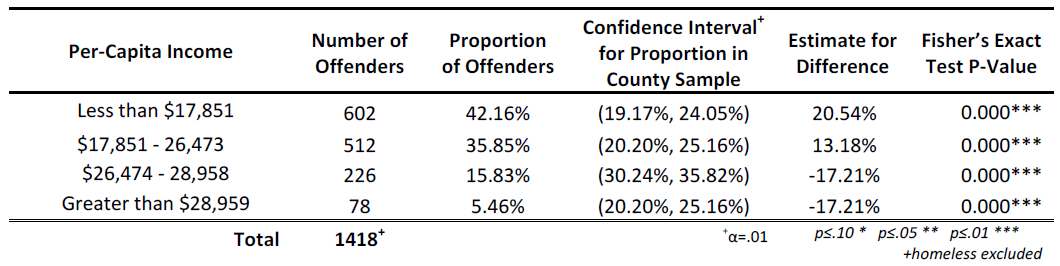
2. Compared to the county as a whole, offenders are substantially more likely to live in lower-income neighborhoods. Nearly three-quarters live in areas where the number of individuals in poverty is above the county median, compared with only 38.77 percent of the county as a whole. An overwhelming majority (83%) live in areas where median rent is below the county median, compared with half of all county land as a whole. For every $10,000 decrease in median income, an offender is 3.22 times more likely to live in that area.
Figure 1 a&b. – Distribution of offenders in the county, by zip code and income.
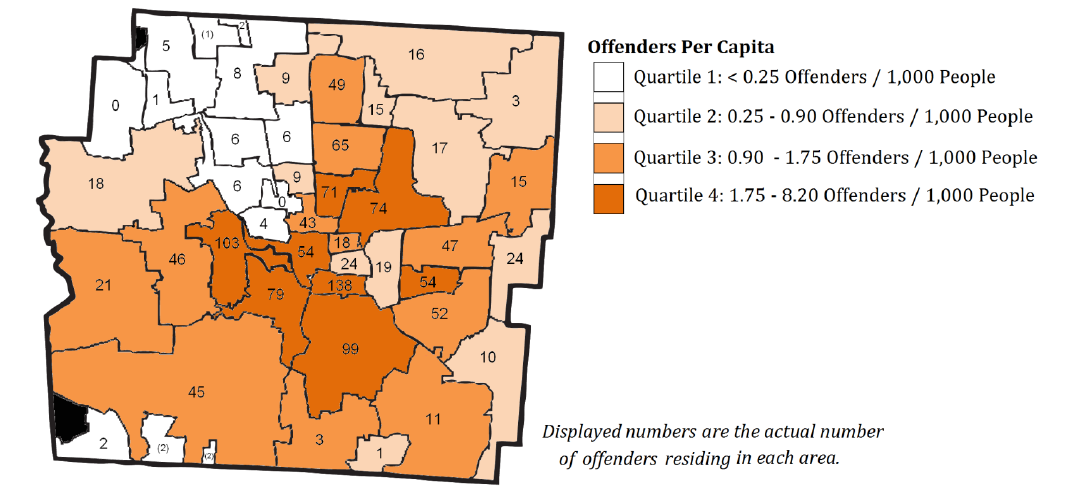
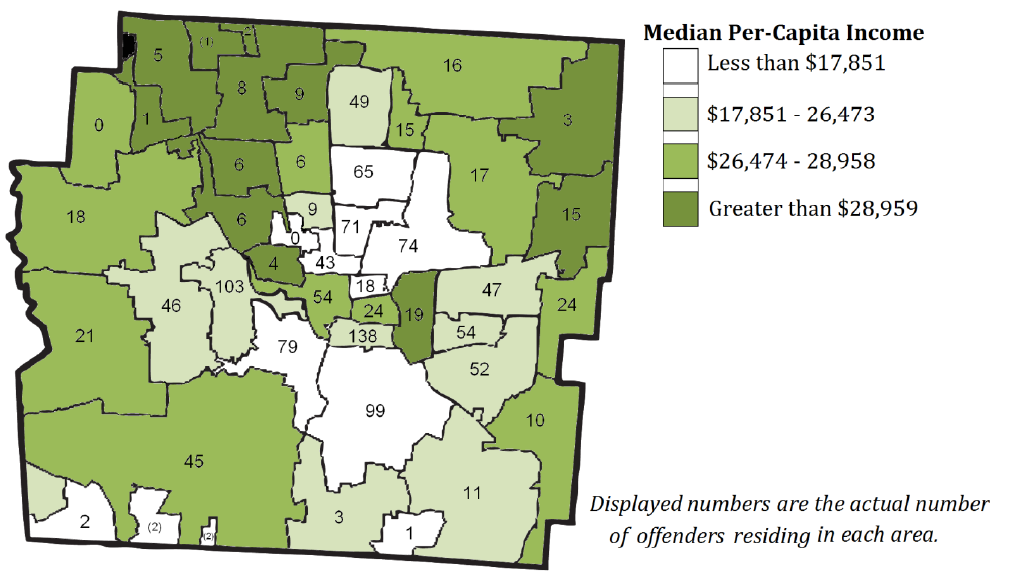
Table 1. – Relationship between income and offender residency.
3. Residency restrictions render substantial portions of the county ‘off limits’. Overall, 59.53% of all residential parcels samples were restricted. When adjusted to include non-residential parcels, an estimated 65.32 percent of the county is unlivable under current restrictions.
4. The proportion of parcels restricted is directly related to economic factors of the area. Among high poverty areas, an astounding 80 percent of sampled parcels are within a prohibited buffer zone. Within all four economic variables, based on regression analysis and modeling, the proportion of parcels violating a residential buffer is highest in areas with worst economic conditions. For example, for every 5% increase in poverty rate, a parcel is 1.125 times more likely to be restricted and for every $100 decrease in median rent a parcel is 1.143 times more likely to be restricted, indicating that economics also play a role in predicting parcel restriction.
Table 2. – Relationship between income and probability of violating restrictions.
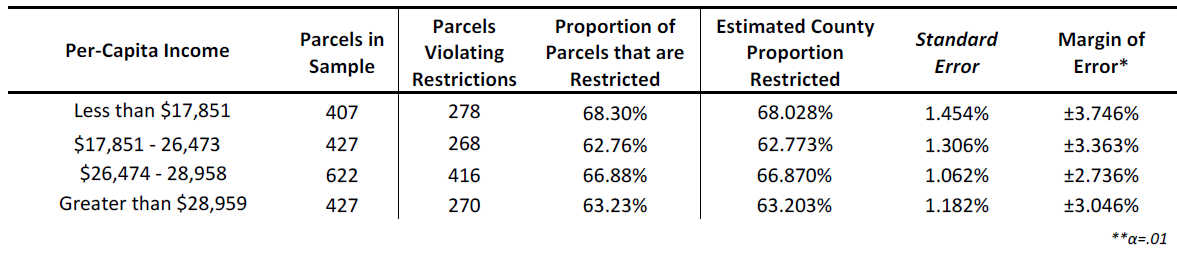
5. While housing in the county is available, albeit only moderately, the availability of affordable housing, given the economic conditions where offenders tend to reside, is much more significantly constrained. For example, when examined by income, less than 32% of parcels are estimated to be available in areas with the lowest median per-capita income, but more than 42 percent of all offenders live in these areas. This pattern is evident across all economic indicators.
6. Hughes and Kadleck (2008) argue that concentration of offenders in low-income areas may be the result of collective action on the part of residents in more affluent areas, using their resources to force offenders out of their neighborhoods. However, Zevitz (2003) found that, while the presence of a sex offender tended to create resident anxiety and anger, no collective reactions were evident. This supports a more simple explanation, that offenders live in poor areas because they cannot afford to live elsewhere. Surveys by Levenson and colleagues (Levenson and D’Amora 2007; Levenson and Tewksbury 2009) find that offenders report difficulty with jobs and financial stability, and this study’s employment rate of 37.99 percent is also supportive of such a conclusion.
7. It has been proposed, given the increased probability that parcels within poor areas are within buffer zones, that offenders locate themselves in poor areas to be closer to potential victims. However, this study rejected that possibility as specious, for two reasons. First, economic factors play a substantial role in predicting where sex offenders live, but have a reduced (though still substantial) role in determining parcel restriction. Thus, offenders would still have access to restricted locations, and by extension possible victims, in more affluent areas. Second, in Ohio, where the minority of offenders are child-victim offenders (Office of Criminal Justice Services 2006), the majority of offenders would have no reason to position themselves within a buffer zone, even if they had the intention to re-offend. A more rational explanation for the clustering of offenders in economically disadvantaged areas is that offenders are themselves economically disadvantaged.
Table 3. – Relationship between violation and area factors, including presence of children.
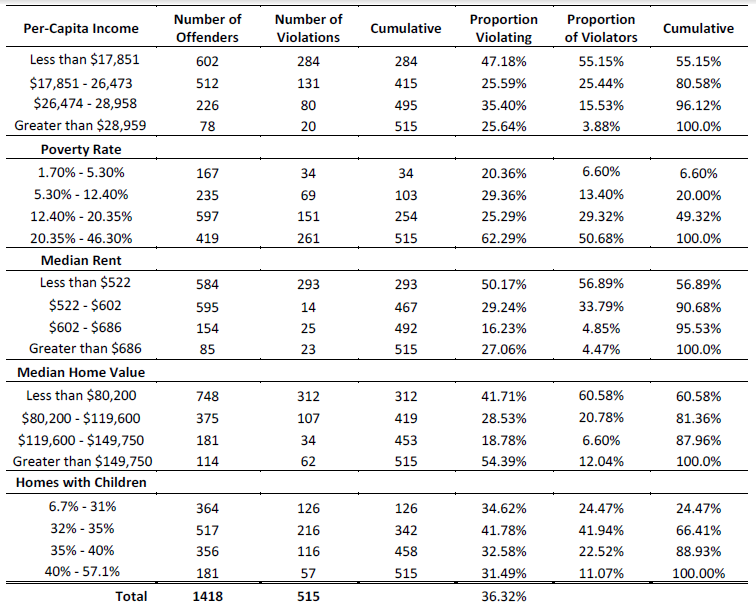
8. This study was able to empirically demonstrate that there is no relationship between offender location and proportion of area homes with children. In fact, as the proportion of area homes with children increases, the likelihood of an offender residing in the area decreases.
9. Economic factors play an important role in predicting where offenders live. In areas with the lowest median income, nearly half (47.18%) of all offenders are living in prohibited areas. In other words, offenders living in poor areas are more likely to be in violation. This relationship is most likely the cumulative result of offender concentration and increased restrictiveness in such areas. To put it simply, offenders in such areas are in violation of residency restrictions because they cannot find housing (either because of economic restraints or due to other factors) that does not violate their restrictions.
10. There are practical implications to the high proportion of offenders who are violating current residency restrictions. Should county officials suddenly seek full enforcement of these restrictions, this would immediately displace 515 offenders, placing them at increased risk for homelessness or transience, given the limitations on affordable, available housing.
The contents of this report were the basis of in-person testimony or affidavit testimony in 17 cases, and cited as an authority in briefs submitted to the Ohio Supreme Court.
 Download Full Report
Download Sample Affidavit
Download Testimony Transcript
Hughes, L. A. and C. Kadleck (2008). “Sex Offender Community Notification and Community Stratification.” Justice Quarterly 25(3): 469-495.
Levenson, J. S. and D. A. D’Amora (2007). “Social Policies Designed to Prevent Sexual Violence: The Emperor’s New Clothes?” Criminal Justice Policy Review 18(2): 168-199.
Levenson, J. S., D. A. D’Amora, et al. (2007). “Megan’s Law and its Impact on Community Re-Entry for Sex Offenders.” Behavioral Sciences and the Law 25: 587-602.
Levenson, J. S. and R. Tewksbury (2009). “Collateral Damage: Family Members of Registered Sex Offenders.” American Journal of Criminal Justice.
Zevitz, R. G. (2003). “Sex Offender Community Notification and Its Impact on Neighborhood Life.” Crime Prevention and Community Safety: An International Journal 5(4): 41-61.